
Course Overview:
01
02
03
Event Schedule
- Duration: 30 Hours (divided into modules)
- Lectures: Expert presentations on each module’s topics.
- Case Studies: Analysis and discussion in small groups.
- Workshops: Practical exercises and simulations.
- Q&A Sessions.
- Price for course 85,000 AMD
- Early Bird: 75,000 AMD before September 15th
Modules
- Overview of Sports Law: Definitions, scope, and significance.
- Sources of Sports Law: National laws, international conventions, and regulations
- Key Legal Principles: Contracts, torts, intellectual property, and labor law in sports.
- Role of Governing Bodies: FIFA, IOC, UEFA, etc.
- Regulatory Frameworks: Anti-doping regulations, athlete eligibility rules, and disciplinary procedures.
- Ethical Issues: Fair play, integrity, and sportsmanship
- Athlete Contracts: Rights, obligations, and disputes.
- Agent Representation: Role, responsibilities, and legal considerations.
- Negotiation Strategies: Drafting and reviewing contracts.
- Arbitration vs. Litigation: Pros and cons.
- Court of Arbitration for Sport (CAS): Structure and jurisdiction.
- Case Studies: Landmark disputes and their resolutions.
- Trademarks and Licensing: Protection of team logos, names, and merchandise.
- Broadcasting and Media Contracts: Rights distribution and revenue sharing.
- Digital Media: Challenges and opportunities.
- Player Rights: Transfers, termination, and compensation.
- Discrimination Issues: Gender, race, and disability in sports employment.
- Collective Bargaining Agreements: Negotiations and legal implications.
- Hosting Major Events: Bidding processes and legal requirements.
- Security and Safety: Legal obligations and risk management.
- Commercial Exploitation: Sponsorship, advertising, and marketing.
- Corporate Governance: Transparency and accountability.
- Ethical Standards: Codes of conduct and compliance.
- Risk Management: Legal implications of crisis management.
- Real-life Scenarios: Analysis of legal issues in recent sports controversies.
- Role-playing Exercises: Negotiation simulations and arbitration scenarios.
- Technology in Sports: Virtual reality, data analytics, and e-sports.
- Globalization: Cross-border transactions and legal challenges.
- Environmental Sustainability: Green initiatives and regulatory impact.
Program Objectives
Case Studies
Explore real-world applications to bridge the gap between theory and practice, offering participants hands-on learning experiences.
Panel Discussions
Engage with industry leaders for valuable insights, fostering a broader understanding of trends and challenges in IT, AI, and law.
Networking Opportunities
Build cross-disciplinary relationships, promote knowledge sharing, and encourage collaborative problem-solving.
Who Should Attend?
IT Professionals
Deepen your understanding of IT and AI's impact on compliance, risk management, and organizational strategy.
IT Engineers
Learn about the legal frameworks shaping technology development and gain essential knowledge for informed decision-making.
Lawyers
Stay ahead of technological advancements and understand their implications for legal practice and policy development.
Course Highlights
- Comprehensive Education
- Practical Learning
- Networking Potential
- Certification and Professional Recognition
- Internship Opportunity
Dates & Venue
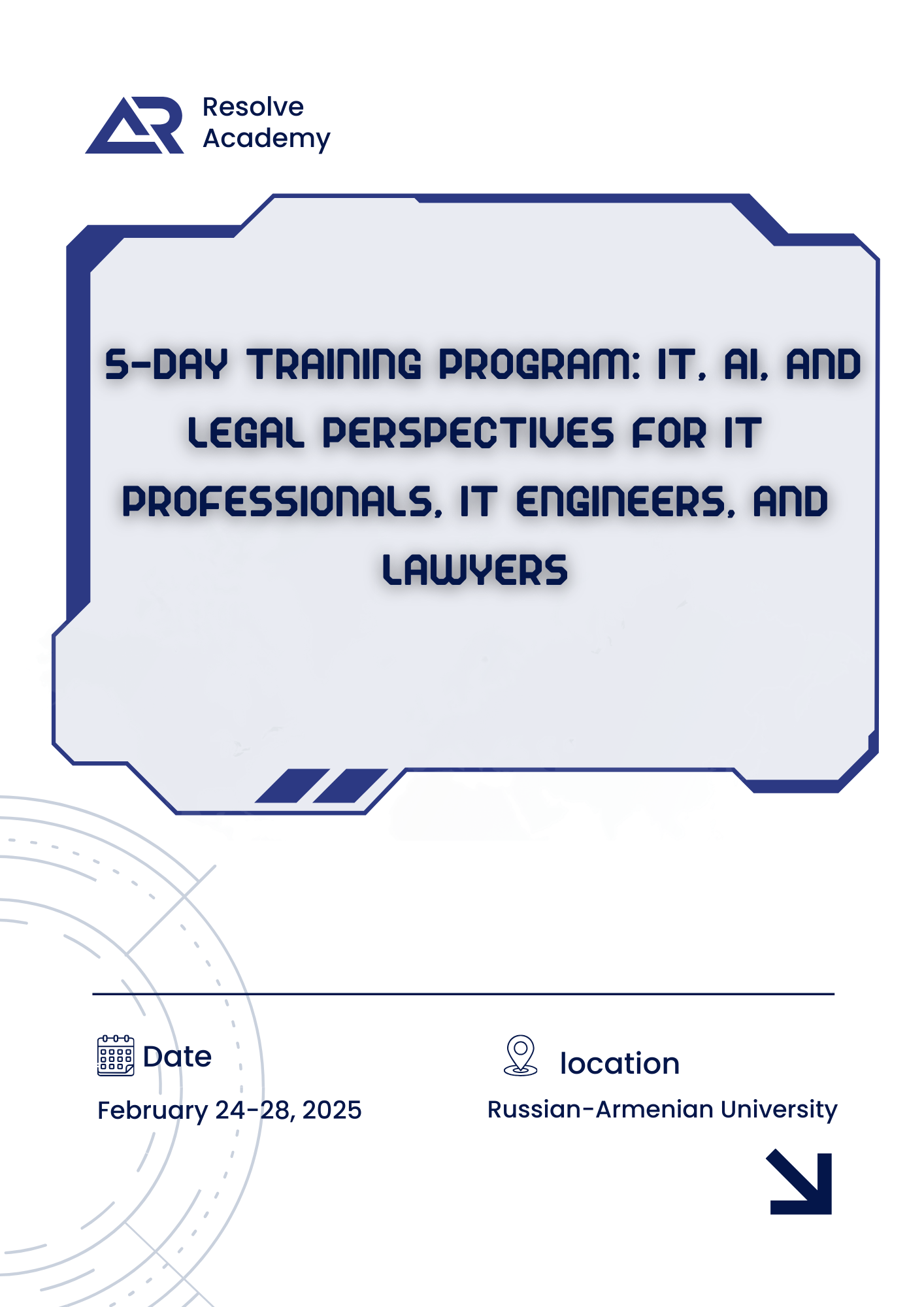
- Venue: Yerevan, Russian-Armenian University
- Dates: February 24-28, 2025
- Registration Deadline: February 14, 2025
Pricing
Audience Fee (AMD)
- 1. Russian-Armenian University: 20,000 AMD
- 2. Other university students: 30,000 AMD
- 3. Online Participants: 40,000 AMD
- 4. Lawyers & Other Professionals: 65,000 AMD
Key Topics
- Overview of IT and AI technologies
- The evolving role of technology in legal practice
- Case studies: Successful integration of IT in legal firms
- Understanding Legal Frameworks
- Introduction to technology-related laws (e.g., data privacy, cybersecurity)
- Overview of AI regulations and guidelines
- Ethical considerations in AI deployment
- Data Protection Laws
- GDPR and its global implications
- CCPA and other regional data protection laws
- Best practices for compliance
- Cybersecurity Challenges
- Understanding cybersecurity threats in the legal sector
- Legal responsibilities for data breaches
- Developing a cybersecurity strategy: collaboration between IT and legal teams
- AI Technologies Overview
- Introduction to IT and AI in the Legal Landscape
- The Intersection of IT, AI, and Law
- Key AI technologies: machine learning, natural language processing, and robotics
- Applications of AI in legal research and contract analysis
- Limitations and risks associated with AI in legal settings
- Regulatory Challenges
- Current regulatory landscape for AI
- Discussion on AI bias and accountability
- Framework for ethical AI use in legal practice
- Establishing a governance framework for IT and AI in legal contexts
- Importance of interdisciplinary collaboration
- Developing policies and procedures for compliance
- Risk Management Strategies
- Identifying risks associated with IT and AI
- Tools and methodologies for risk assessment
- Creating a risk management plan
- Emerging Technologies in Law
- Future technologies shaping the legal landscape (e.g., blockchain, smart contracts)
- Predictions for AI and legal practice in the next decade
- Skills required for IR professionals, IT engineers, and lawyers in the evolving landscape
- Developing a Collaborative Culture
- Fostering collaboration between IT and legal teams
- Importance of continuous learning and adaptation
- Strategies for effective communication across disciplines